IYPT 2026
IYPT 2026 – Zürich, Switzerland
(5. July – 12. July 2026)

General Information
The 39th International Young Physicists’ Tournament was held in Zurich, Switzerland, from 5 to 12 July 2026 and was hosted by ETH Zurich.
The tournament brought together high school students, team leaders, jurors, and guests from around the world for a week of physics, scientific discussion, teamwork, and international exchange.
During IYPT 2026, participants presented and defended their solutions to the seventeen open-ended physics problems in the unique IYPT “Physics Fight” format. Through scientific discussion and debate, teams demonstrated their creativity, experimental skills, and ability to communicate complex ideas.
The tournament programme included the Opening Ceremony, five Selective Physics Fights, the Final Fight, social and cultural activities, an excursion programme, and the Closing Ceremony. Beyond the scientific competition, participants had the opportunity to explore Zurich and its surroundings, discover Swiss culture, and spend time together through various social activities. The excursion programme allowed participants to experience local sights and landmarks, while informal gatherings and shared activities created opportunities to build friendships and strengthen the international IYPT community. The week offered participants not only an opportunity to compete at the highest level but also to exchange ideas, meet peers from around the world, and experience the scientific environment of ETH Zurich.
The event was organised by the Local Organizing Committee in cooperation with ETH Zurich and the International Organizing Committee, with the support of sponsors, partners, jurors, and volunteers who contributed to the success of IYPT 2026.
Finals 2026
After the fifth selective Physics Fight, the teams of Singapore, China, and South Korea advanced to the Final of the 39th International Young Physicists’ Tournament, held in Zurich, Switzerland.
Team Singapore delivered an outstanding performance in the Final and secured first place with 47.86 points. South Korea followed with 42.50 points, while China finished in third place with 38.93 points.
The teams presented the following problems:
Singapore: Problem 15 – Magnetic Newton’s Cradle
South Korea: Problem 5 – Elastic Wave Dynamics
China: Problem 8 – Magnetic Accelerator
The Final Fight took place in front of an international jury and an engaged audience, showcasing the highest level of scientific discussion, creativity, and teamwork.
Ranking after the last selective physics fight
| Rank | Team | Medal |
| 1. | Singapore | 🏅Gold |
| 2. | Korea | 🏅Gold |
| 3. | Germany | 🏅Gold |
| 4. | Czechia | 🏅Gold |
| 5. | China | 🥈Silver |
| 6. | Chinese Taipei | 🥈Silver |
| 7. | Slovakia | 🥈Silver |
| 8. | Switzerland | 🥈Silver |
| 9. | New Zealand | 🥈Silver |
| 10. | Serbia | 🥈Silver |
| 11. | Georgia | 🥉Bronze |
| 12. | Ukraine | 🥉Bronze |
| 13. | Hong Kong | 🥉Bronze |
| 14. | Austria | 🥉Bronze |
| 15. | Hungary | 🥉Bronze |
| 16. | Thailand | 🥉Bronze |
| 17. | Brazil | 🥉Bronze |
| 18. | Bulgaria | 🥉Bronze |
| 19. | USA | honorable mention |
| 20. | India | honorable mention |
| 21. | Sweden | honorable mention |
| 22. | Kazakhstan | honorable mention |
| 23. | South Africa | honorable mention |
| 24. | United Kingdom | honorable mention |
| 25. | Italy | honorable mention |
| 26. | Canada | honorable mention |
| 27. | Poland | honorable mention |
| 28. | Croatia | |
| 29. | Pakistan | |
| 30. | Greece | |
| 31. | Australia | |
| 32. | Romania | |
| 33. | Mexico | |
| 34. | Nepal | |
| 35. | Japan |
Complete results and rankings of teams at IYPT 2026 are available at: https://iypt.ch/index.php/plans-and-rankings/ranking
Gallery
You can find a selection of official photos from the tournament at the link below:
🔗 Photo Gallery
🔗 Google Drive Photo Gallery
For more highlights, behind-the-scenes moments, and stories from the week, visit our Instagram:
📲 @iypt_tournament on Instagram
Make sure to tag us if you share your own IYPT memories!
Posts from IYPT 2026
13.7.2026
IYPT 2026 Photos
The first photos from IYPT 2026 are now available. More photos will be added gradually over the coming days, so be sure to check back regularly for the latest updates.
📸PHOTO GALLERY IYPT 2026
📸PHOTO GALLERY IYPT 2026
11.7.2026
🔴 The IYPT 2026 Final is about to begin!
The moment we’ve all been waiting for is here. Tune in live and watch the world’s best young physicists compete in the Final of the 39th International Young Physicists’ Tournament.
📺 Watch the livestream here: https://event.swisscom.ch/v/eth-live-1/live/mainstage
19.6.2026
Jury Briefing Recording and Scoresheet Assignment
Thank you to everyone who participated in the online Jury Briefing.
For those who were unable to attend, the recording of the session, together with all supporting materials, is available at the link below:
https://drive.google.com/drive/folders/1vCatszUszSqf-iUYunU4zXf2DcmhhllB
The briefing provides important guidance on the evaluation process and instructions for completing the scoresheet.
All first-time jury members are kindly requested to review the materials, complete the scoresheet based on the provided model presentation, and submit it by 26 June 2026.
Completed scoresheets may be submitted either as a scanned copy or in digital format.
Thank you for your cooperation, and we look forward to welcoming you to IYPT 2026.
16.6.2026
Jury Briefing for First-Time Jurors
All first-time jury members are invited to participate in the online Jury Briefing on 17 June 2026 at 14:00 CET. The session will introduce the evaluation process, scoring criteria, and jury responsibilities. Participants will also complete a practical evaluation exercise based on an example presentation.
Please find the official invitation and further details in the attached PDF.
10.6.2026
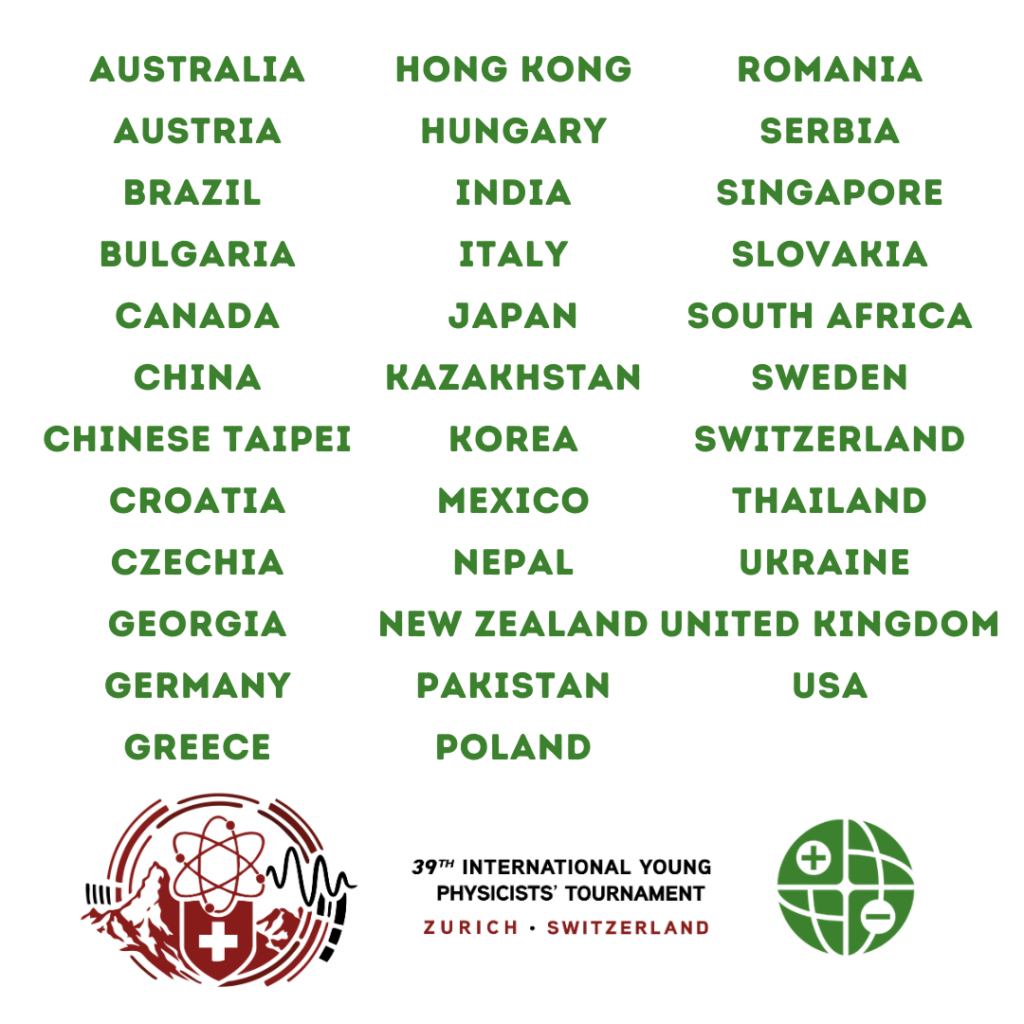
Registered Countries for IYPT 2026
We are pleased to announce the registered countries for the 39th International Young Physicists’ Tournament, taking place in Zurich, Switzerland.
The strong international participation once again reflects the global spirit of IYPT, bringing together talented young physicists from across the world to engage in scientific discussion, collaboration, and discovery.
With the tournament now less than a month away, we are looking forward to welcoming all participants to Zurich for an exciting and inspiring week of physics.
5.5.2026
Registration Deadlines Update
All visitors, IOC members, and potential jurors must be registered by May 15th.
All team members and team leaders must be registered by May 25th.
Detailed information has already been shared with IOC delegates.
3.5.2026
Congratulations to our IYPT stars!
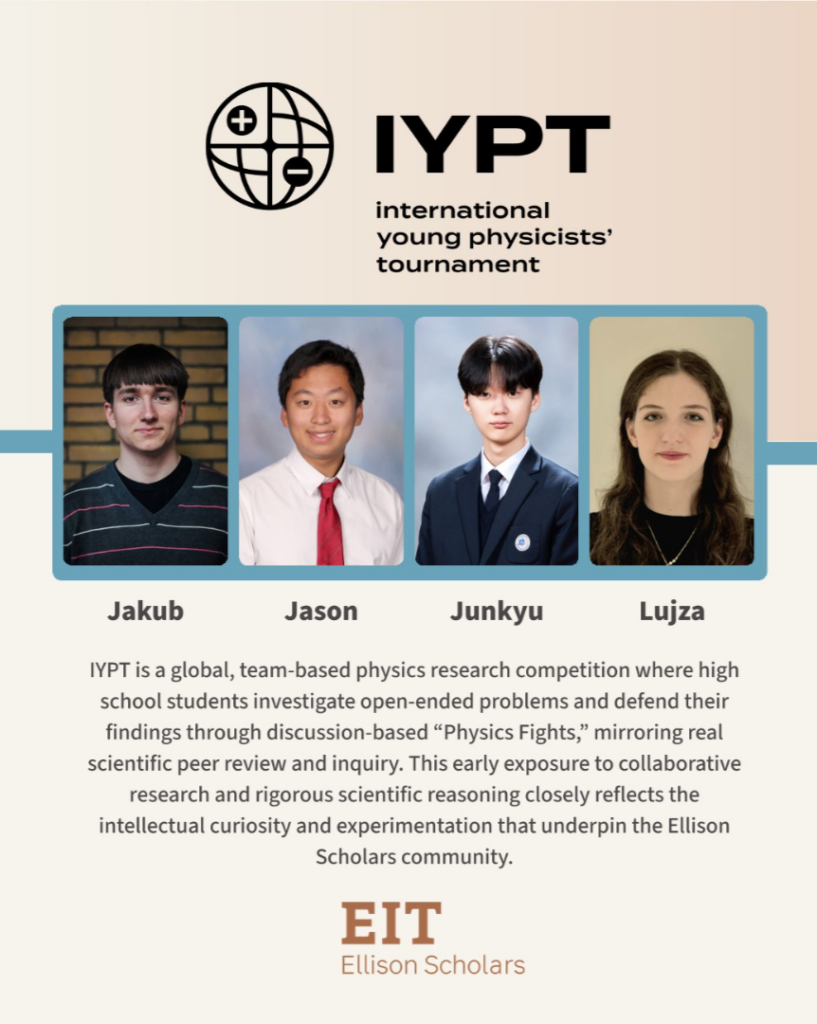
We’re thrilled to celebrate Jakub Nemček, Lujza Lea Lavriková, Junkyu Kang, and Jason Tao, who have been selected as incoming Ellison Scholars Ellison Institute of Technology Oxford! 🏅✨
Your hard work, curiosity, and passion for science have truly paid off — we couldn’t be prouder! 💡🌍
4.4.2026
Second Round of Juror Applications Open
We are pleased to announce that a second round of applications for jurors for IYPT 2026 is now open. Applications are open until 15 April 2026. Please note that financial support is not available in this round.
Interested applicants can apply via the following link: https://cc.iypt.org/registration/iypt2026/jurors/apply
31.3.2026
Explore the Program Highlights ✨📅
Read more about the key moments and structure of the upcoming IYPT, including competition rounds, social events, and important milestones. Get a glimpse of what to expect and prepare for an engaging and intensive experience. CLICK HERE
15.3.2026
IYPT 2026 – Zurich ✨
To stay up to date with all the news – including dates, program, registration, and behind-the-scenes updates – make sure to follow:
🔗 Official website: iypt.ch
📸 Instagram: @iypt2026
The Instagram page is especially worth following for regular updates and announcements 📢.
👉 Stay tuned – you won’t want to miss anything! 🚀
6.2.2026
Juror Applications for IYPT 2026
If you are not yet registered in the CC as a possible juror, please register first here: https://cc.iypt.org/registration/iypt2026/jurors/apply. As part of the registration, you will be asked to provide a CV in English with your relevant experience in physics.
As in previous years, first-time jurors who have already participated in IYPT in another role may request a fee waiver and travel support.
You can apply as an experienced juror if you have served as a juror in at least one of the last five IYPT competitions. Applications for experienced jurors, as well as for first-time jurors who have completed the initial registration step, can be submitted here: https://cc.iypt.org/registration/iypt2026/role/404/.
The deadline for all applications is 28 February 2026.
We look forward to receiving your applications and welcoming you to IYPT 2026!
24.12.2025

21.11.2025
Report from Inspection Visit to Zurich
In October, EC members, the LOC, and the IYPT Office met in Zurich, Switzerland, for an inspection visit and planning meetings for the upcoming tournament. We encourage all participants to read the report linked below, as it contains useful information about IYPT 2026.
Inspection Visit Report
7.7.2025
Problems for the 39th IYPT 2026
1. Invent yourself
A self-starting siphon can be made using a piece of rigid tubing bent into a specific shape. When the siphon is partially immersed in water, it begins siphoning water without the need for initial suction. Investigate how the relevant parameters, such as the geometry, affect the siphoning process.
2. Electrical damping
A magnet suspended by a spring will display simple harmonic motion when displaced. If the magnet oscillates within a coil connected to a resistor, its motion will be damped. Investigate the factors that affect the damping.
3. Ring fountain
When a flat metal ring falls from a certain height into a water tank, it generates a fountain that can shoot water high into the air. How does the maximum height of the fountain depend on the ring’s parameters?
4. Oil flow
A thin layer of cooking oil on a flat metal surface flows outwards when heated. Investigate the phenomenon and its dependence on relevant parameters.
5. Elastic wave dynamics
Suspend a metal ball from a fixed support using a rubber band and twist it many times around its vertical axis. When the ball is released, standing waves are formed on the rubber band. Investigate this phenomenon and study how the wave depends on relevant parameters.
6. Flipo Flip
A Flipo Flip toy can roll for multiple turns even though its shape is not circular. Investigate how its motion depends on parameters such as geometry and the initial release conditions.
7. Tennis racket theorem
When an object with different principal moments of inertia about each axis is thrown while it rotates, it can suddenly start rotating around an axis different from the one it was initially rotating about. Investigate how the rotational motion of such an object is affected by relevant parameters during its free fall.
8. Magnetic accelerator
Fix magnets in pairs onto a metal sheet as shown. If you attach two magnetic discs onto an axle this “vehicle” will accelerate over the rows of magnets under certain conditions. Investigate the phenomenon.

9. Levitation control
When arranged in a specific configuration, small graphite sheets can levitate on neodymium magnets. By shining light onto the surface of the graphite sheet, it is possible to control its movement. Explain and investigate the phenomenon.
10. Submerged crater
If you release sand or similar granular material in a container filled with water, the material will sink to the bottom and may form a crater-like structure. Explain and investigate the phenomenon.
11. Sweet monochromator
Pass linearly polarised white light through a column of sugar solution. When transmitted light is observed through a polariser it may appear coloured. Rotate the polariser, and the transmitted light colour may change. Construct such a sweet monochromator and optimise for the narrowest light wavelength bandwidth.
12. Autumn coin
The motion of a coin falling to the bottom of a tank filled with liquid can be remarkably similar to the fluttering and tumbling of a falling autumn leaf. Investigate how the motion of the coin depends on relevant parameters.
13. The singing ruler
When a ruler is clamped at one end and struck, it oscillates and emits a characteristic sound. Investigate how the sound depends on relevant parameters.
14. Crystal Critters
Observe the evaporation of a drop of table salt solution on a warm hydrophobic surface. After the water evaporates, a variety of characteristic crystal shapes remain. Research and explain this phenomenon.
15. Magnetic Newton’s cradle
Repulsing, non-touching magnets are used instead of colliding balls to make a new type of Newton’s cradle. The new cradle can act in a similar way to a regular cradle, but can also exhibit other interesting behaviour. Explain and study the movement of this magnetic cradle.
16. Twisted spaghetti
When a bundle of spaghetti is twisted, it might withstand higher transverse (side) forces than a straight, untwisted bundle. Investigate the response of a twisted bundle to transverse stress and identify the optimal twist that maximises tolerance to transverse stress.
17. Travelling flame
A flame can propagate continuously around a ring-shaped trough containing a thin layer of flammable liquid. Investigate how the characteristics of this travelling flame depend on relevant parameters.
Submitted by:
Mirkin Alex, Yuchong Chen, Jim Chen, Nikita Chernikov, Falk Ebert, Sam Edgecombe, Ivan Guilhon, Kent Hogan, Karel Kolář, Heiko Krabbe, Amanda Leung, Fabricio Marques, Leandro Oliveira, Ilya Martchenko,
Irakli Mirotadze, Rusheen Sal Nuthalapati, Zixuan Peng, Felix Wechsler
Special thanks to:
Gavin Jennings, Samuel Byland, Fabricio Marques, Liane Brandt, Michael Steck